
Virtual Library....
Last updated: 4/21/2026.
For creative work that was shared by classmates over the course of our 45th Reunion, please turn to this page.
To submit additional entries or correct content, visit this page.
| Classmate,Pic (click for larger image) |
Title | Pub, Year | Description | For more information... | ||||||
|---|---|---|---|---|---|---|---|---|---|---|
| Gilligan, Diana | ||||||||||
| Pandita A, Ramadas P, Poudel A, Saad N, Anand A, Basnet A, Wang D, Middleton F, Gilligan DM., Differential expression of miRNAs in acute myeloid leukemia quantified by Nextgen sequencing of whole blood samples |
PLOS One, 2019 | The epigenetic regulation of gene expression is likely to provide new insights into the molecular basis of leukemia and new approaches for treatment. We have analyzed miRNA expression in blood samples from patients with distinct subtypes of AML using an unbiased total sequencing approach and we have published the first analysis of this type. | available from this link | |||||||
| Rabenstein RL, Addy NA, Caldarone BJ, Asaka Y, Gruenbaum LM, Peters LL, Gilligan DM, Fitzsimonds RM, Picciotto MR., Impaired synaptic plasticity and learning in mice lacking beta-adducin, an actin-regulating protein. |
J Neurosci, 2005 | Adducin is recognized as an important cellular component in learning and the molecular aspects of memory formation. I had previously demonstrated that beta adducin is highly expressed in brain, in contrast to other tissues. We determined that beta adducin knockout mice have a learning disability and this was the first molecule directly linked to memory formation via a knockout technique. | available from this link | |||||||
| Gilligan DM, Sarid R, Weese J., Adducin in platelets: activation-induced phosphorylation by PKC and proteolysis by calpain. |
Blood, 2002 | Human platelets are a model system for stimulus-secretion coupling and actin filament elongation. We demonstrated that adducin is phosphorylated in response to platelet activation and rapidly proteolyzed by calcium dependent calpain as platelets undergo a functional shape change. | available from this link | |||||||
| Gilligan DM, Lozovatsky L, Gwynn B, Brugnara C, Mohandas N, Peters LL., Targeted disruption of the beta adducin gene (Add2) causes red blood cell spherocytosis in mice. |
Proc Natl Acad Sci U S A., 1999 | I published the genomic organization of the beta adducin gene and its two promoters, one erythroid-specific and one neural-specific. I generated the first adducin knockout mouse (Add2 or beta) and demonstrated the phenotype of spherocytosis in these mice. | available from this link | |||||||
| Gilligan, DM and Satir, BH, Protein phosphorylation/dephosphorylation and stimulus-secretion coupling in wild type and mutant Paramecium. |
J Biol Chem, 1982 | Our lab worked with a well defined collection of spontaneous mutants with structural defects in the secretory apparatus. I discovered that a phosphoprotein underwent dephosphorylation in a calcium-dependent manner during the process of stimulus-secretion coupling. Subsequently, this protein was named “parafusin”, has been studied in liver, and plays a role in membrane fusion. | available from this link | |||||||
| Phua, Kai Hong | ||||||||||
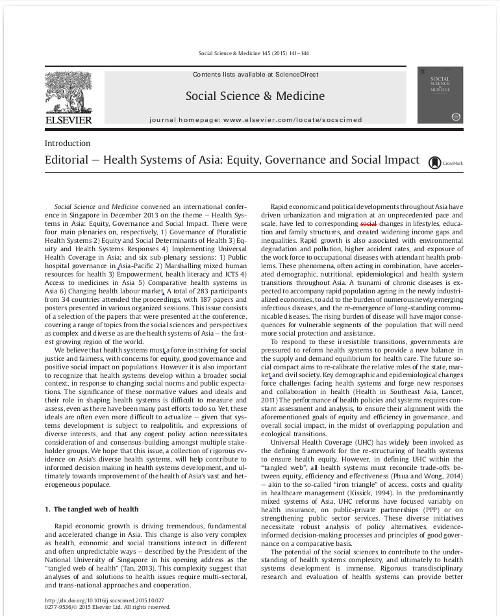 |
KH Phua, K Sheikh, SL Tang, Lin V (Editors), Editorial - Health Systems in Asia: Equity, Governance and Social Impact |
Elsevier, 2015 | Social Science & Medicine convened an international conference in Singapore in December 2013 on the theme “Health Systems in Asia: Equity, Governance and Social Impact”. This issue consists of a selection of the papers that were presented at the conference, covering a range of topics from the social sciences and perspectives as complex and diverse as are the health systems of Asia in the fastest growing region of the world. | available from Science Direct | ||||||
| Richardson, Katherine | ||||||||||
 |
Rockstrom, J., K. Richardson et al, Planetary Boundaries guide humanity’s future on Earth |
Nature, 2024 | Provides a history of the evolution of the Planetary Boundaries (PB) framework of which I am an architect. The biodiversity and climate crises make it clear that, in addition to local and regional environmental management, humanity must now also manage its interactions with the planet as a whole. The PB framework provides guidelines for this management and I now frequently used in policy. | Read more here available from this link |
||||||
 |
Richardson, K. & M. Rosing, Timescales in the Biosphere and Geosphere: Importance in establishing Earth system state |
Springer Nature, 2024 | The overall state, i.e., the environmental conditions, of planet Earth have, for the last 3.5 billion years been largely determined by the interaction between life (biosphere), the Earth’s abiotic components (geosphere) and the Earth’s energy balance. In this book chapter, we compare and contrast, the roles of the biosphere and geosphere in establishing Earth system state. This is a chapter in the book Multiplicity of Time Scales in Complex Systems | available from this link | ||||||
| |
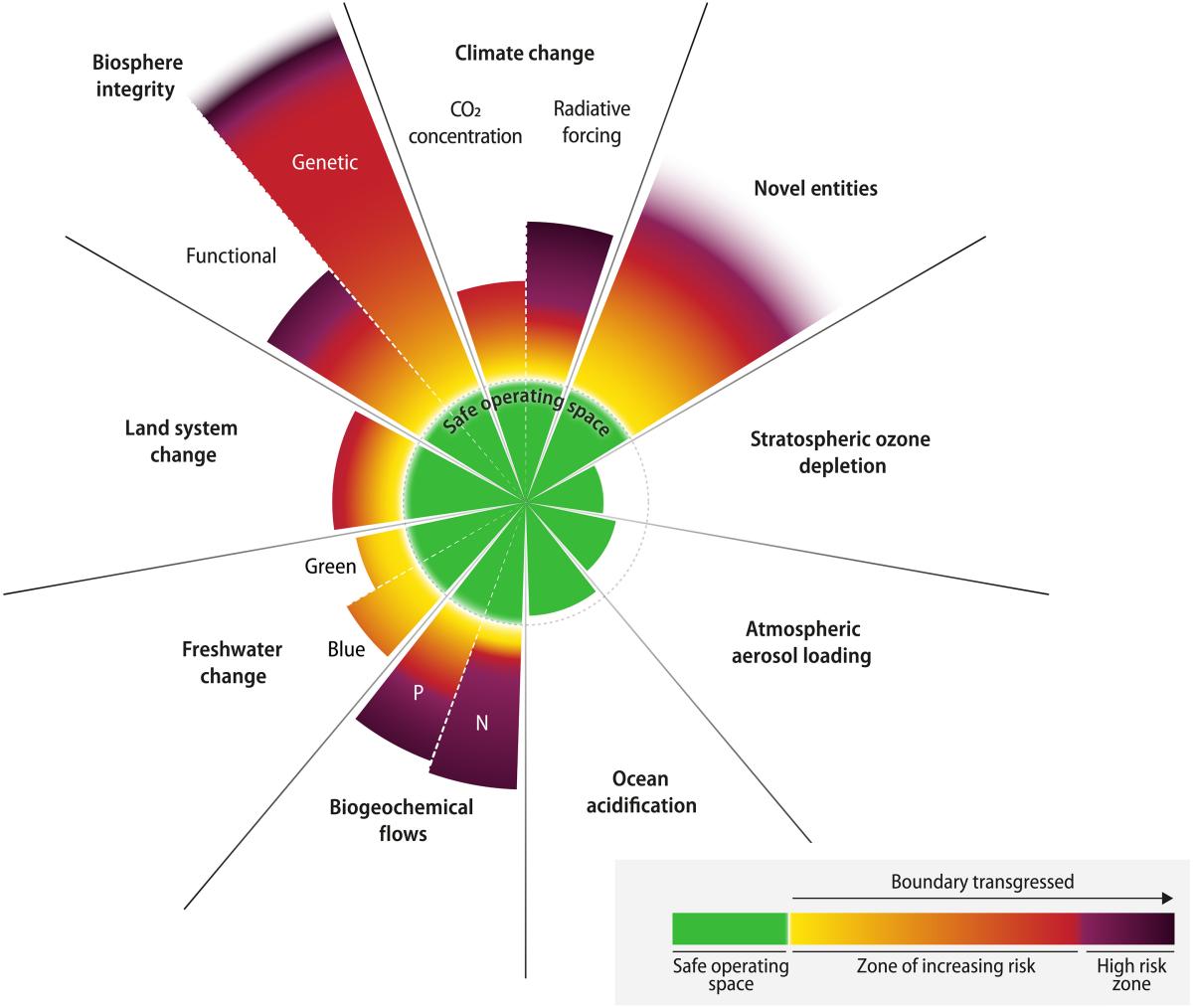
Richardson, K. et al, Earth beyond six of nine planetary boundaries |
Science, 2023 | The 3rd update of a framework of which I am an architect in which we identify 9 processes in the Earth system that are critical for maintaining the environmental conditions that have allowed modern civilizations to develop. We propose a “safe operating space” for human activities and find that humanity has surpassed the boundaries for this safe operating space for 6 of the 9 processes. The article has attracted enormous attention and has been downloaded almost 800,000 times. | Read more here available from this link |
||||||
 |
Lenton, T.W., K. Richardson et al, Climate tipping points – too risky to bet against |
Nature, 2019 | The article presents the argument that tipping points in the Earth system represent a real and urgent risk for our civilization and that their existence should cause us to adopt a much more precautionary approach towards the perturbations we are causing in the climate system. | Read more here available from this link |
||||||
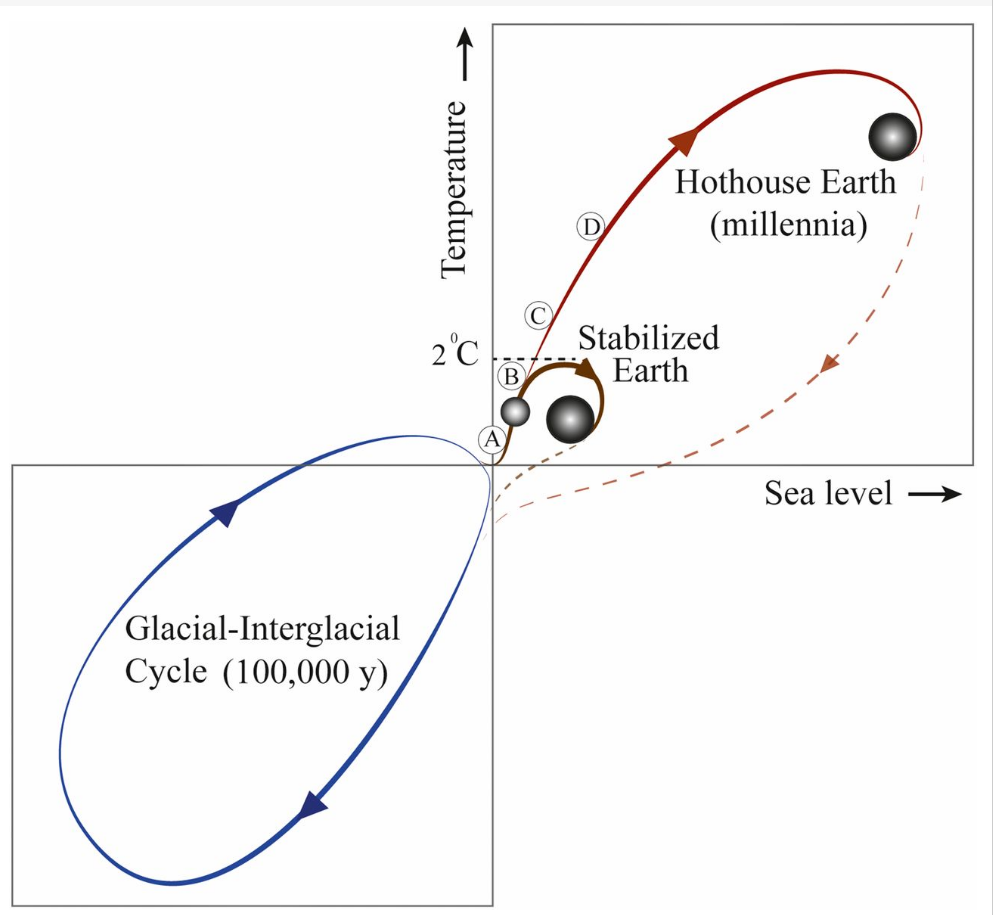 |
Steffen, W., Richardson, K. et al, Trajectories of the Earth System in the Anthropocene |
PNAS, 2018 | The article argues that, at some point in global warming, internal feedbacks within the Earth system can potentially “take control” of climate change from us. In other words, if we allow global warming to proceed too far, the Earth may continue to warm to levels unable to support modern civilizations, i.e., a “hothouse Earth”. | Read more here available from this link |
||||||
| Sokal, Alan | ||||||||||
| Alan Sokal and Richard Dawkins, Sex Assigned at Birth: The medical establishment betrays science, logic and common sense |
The Boston Globe, 2024 | Published in slightly abridged form in the Boston Globe, 8 April 2024. | available from this link | |||||||
|
|
||||||||||